 PDF e-book + Flipbook
Mithila Authenticity Guaranteed
Comes with artisan bio card and registered ChitraVithi seal of authenticity.
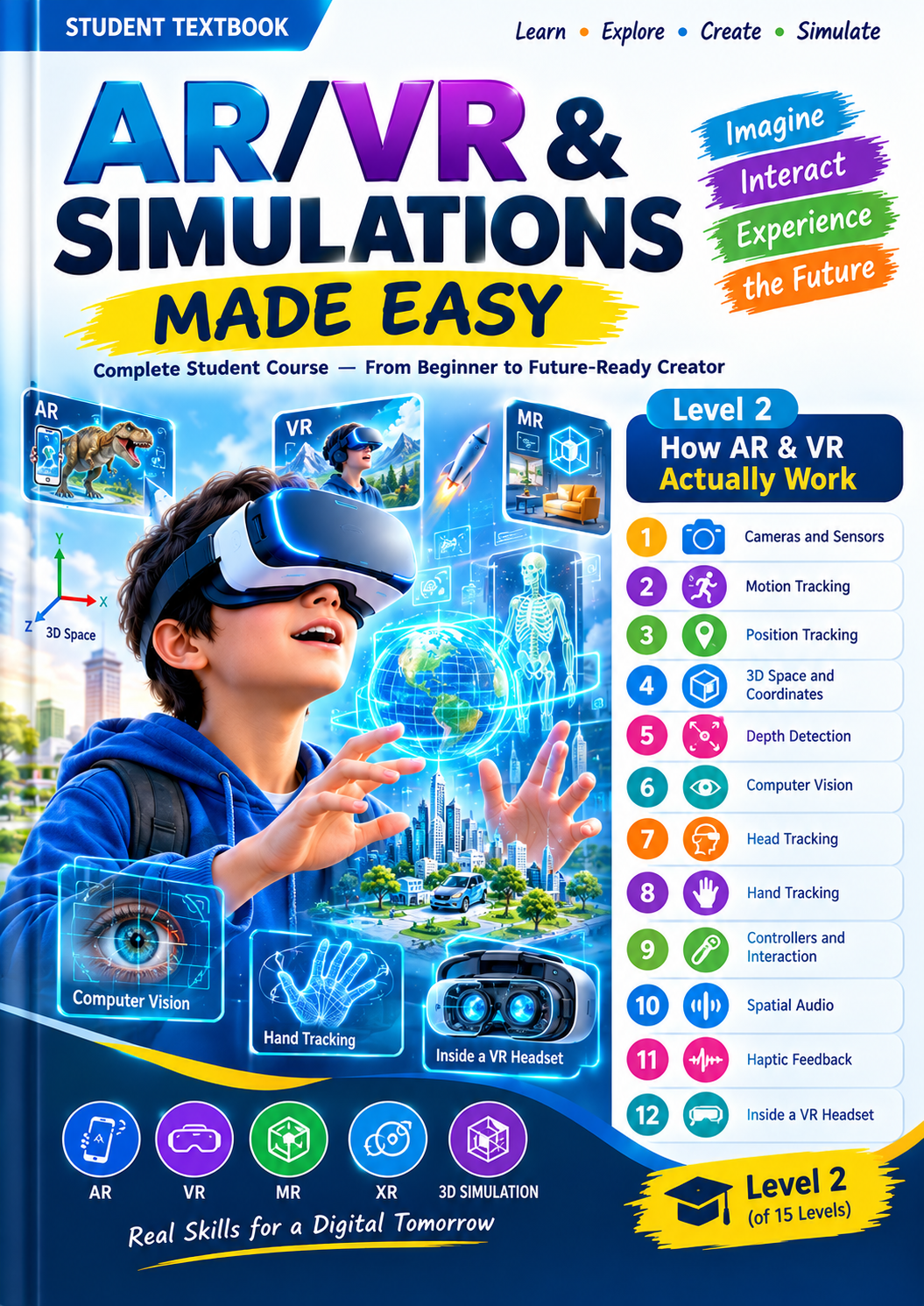
AR/VR & Simulations Made Easy: Level 2, How AR & VR Actually Work
AR/VR & SIMULATIONS MADE EASY — LEVEL 2,Complete Student Course — From Beginner to Future-Ready
Bespoke Personalization
Cultural Significance & Folklore
AR/VR & Simulations Made Easy: Level 2, How AR & VR Actually Work
Go beyond “what is VR?” and discover how it actually works!
Your child already knows what AR, VR, MR and XR are. Now they get to look under the hood. Level 2 explains the cameras, sensors, tracking, depth, vision, sound and touch that make virtual worlds feel real. It is written in simple language, with colourful diagrams and hands-on activities, and it needs almost no equipment.
What’s Inside
12 engaging lessons
1. Cameras and Sensors
2. Motion Tracking
3. Position Tracking
4. 3D Space and Coordinates
5. Depth Detection
6. Computer Vision
7. Head Tracking
8. Hand Tracking
9. Controllers and Interaction
10. Spatial Audio
11. Haptic Feedback
12. Inside a VR Headset
Every lesson follows the same easy 8-step path:
Concept → Simple Explanation → Visual Diagram → Real-Life Example → How It Works → Student Activity → Mini Quiz → Project Challenge
Plus You Get
• 72 quiz questions with a full Answer Key
• Hands-on “Try It Yourself” activities using paper, tape and everyday objects
• Optional “Digital Activities” for phones and computers
• 12 Project Challenges, ending with the Level 2 Final Project, “Headset Blueprint”
• Glossary of AR/VR terms
• Teacher and Instructor Notes with timings, materials, teaching tips and an assessment scale
• Printable Student Certificate of Completion
• Special boxes throughout: Did You Know?, Quick Fact, Science Behind It, Safety Tip, Future Technology, Challenge Yourself
What Students Will Learn
• How sensors (cameras, IMU, depth sensors, microphones) work together through sensor fusion
• The difference between inside-out and outside-in tracking, and what 6DoF means
• How 3D coordinates work, including a simple use of Pythagoras’ theorem
• How devices measure depth using stereo, time-of-flight, structured light and LiDAR
• How computers “see” through computer vision
• Yaw, pitch and roll, and why delay (motion-to-photon) can cause dizziness
• How hand tracking, controllers, spatial audio and haptics create a feeling of presence
• What is really inside a VR headset: lenses, displays, FoV, refresh rate and IPD
Perfect For
• Students curious about technology, gaming and the future
• Parents home schooling or enriching STEM learning
• Teachers, coding clubs and after-school STEM programmes
• Schools building a step-by-step AR/VR curriculum (Level 2 of 15)
Why Families and Teachers Love It
• No headset required. Learning works with paper, pencil and curiosity.
• Safety built in. Every activity includes sensible safety and privacy guidance.
• Ready to teach. Timings, materials and assessment ideas are included.
• Skills that last. Builds real understanding of STEM, 3D thinking, design and digital responsibility.
Format: PDF e-book | Length: about 44 pages | Delivery: instant digital download
Important Notice
Please read before you buy.
1. Digital product. This is a PDF e-book. No physical book will be shipped..
2. Refunds. This is an instant download, so all sales are final. If your file is damaged, contact us and we will help.
3. Compatibility. Opens on any PDF reader. Works on computer, tablet or phone.
Publisher: Gunom Academy
Contact: [shrichitravithi@gmail.com, https://www.shrichitravithi.com]
You May Also Admire